
Introduction
Hue Temple of Literature (Văn Miếu Huế or Văn Thánh) is one of the most meaningful cultural and historical sites in the ancient capital. Built during the reign of Emperor Gia Long in the early 19th century, the temple was dedicated to Confucius and honored scholars who contributed to the intellectual life of the Nguyen Dynasty. It stands as a symbol of respect for education, morality, and scholarly achievement in imperial Vietnam.

Most tourists know about the Hanoi Temple of Literature, but not many people know that, in Hue, there is another Temple of Literature under the Nguyen Dynasty that still exists.
Hue Temple of Literature offers a peaceful and spacious setting away from busy tourist routes. Surrounded by old trees and traditional architecture, the site reflects the Confucian philosophy that once strongly influenced Vietnam’s royal court and examination system. It is known as the first university built on the land of the ancient capital.
During your stay in Hue, you may be interested in our Hue Tours such as Hue City Tour Half Day, Hue royal tombs tour, Hue DMZ Tour, Hue street food tour, and Hue City Private Tour.
After a nice stay in Hue, you may need our Hue Private Car transfers to other famous destinations such as
- Hue to Hoi An private car– 1,500,000 VND/ sedan car.
- Hue to Hoi An by Jeep– 4,000,000 VND/ Sedan car.
- Hue to Dong Hoi private car– 1,900,000 VND/ Sedan car.
- Hue to Da Nang private car– 1,400,000 VND/ Sedan car.
- Hue to Phong Nha private car– 2,200,000 VND/ Sedan car.
Hue Temple of Literature Location
The Temple of Literature in Hue is a majestic building complex, located on a low hill, about 5km from Hue city center. It faces in the South direction and overlooks the poetic Perfume River.
It is standing on Van Thanh Road, Long Ho Commune, Hue city. It is just 1km away from Thien Mu Pagoda.
Temple Of Literature Hue History
According to the legend of the Hue Temple of Literature, during the period when the Nguyen kings expanded, built their territory, and explored the South, the first Temple of Literature was built in Trieu Son village. In 1770 (Nguyen Phuc Khoat reign), the Temple of Literature was moved to Long Ho commune and was known as the Temple of Literature of Dang Trong.

In 1802, when the Nguyen Dynasty was first established, the Temple of Literature in Hue was officially built on Van Thanh Street as the present. The old Temple of Literature in Long Ho commune is still kept to worship Khai Thanh Tu (Confucius’ parents).

In addition to being built as a place to worship Confucius, the Temple of Literature in Hue is also a place to worship Manh Tu, Nhan Tu, Tang Tu, TuTu, and other sages who have contributed to the construction and development of Confucianism.

Since its establishment until now, Van Thanh Hue has undergone many repairs and construction of additional works… in 1818, 1822, 1895, and 1903. In 1947, when the French colonialists invaded Vietnam, they devastated this place, causing many buildings to be heavily damaged.

After that, the Temple of Literature in Hue was “forgotten” for a long time. In the past few years, many tourists have visited this place and contributed to making the Temple of Literature Hue become a destination not to be missed on the Hue tourist map.
What to see there?
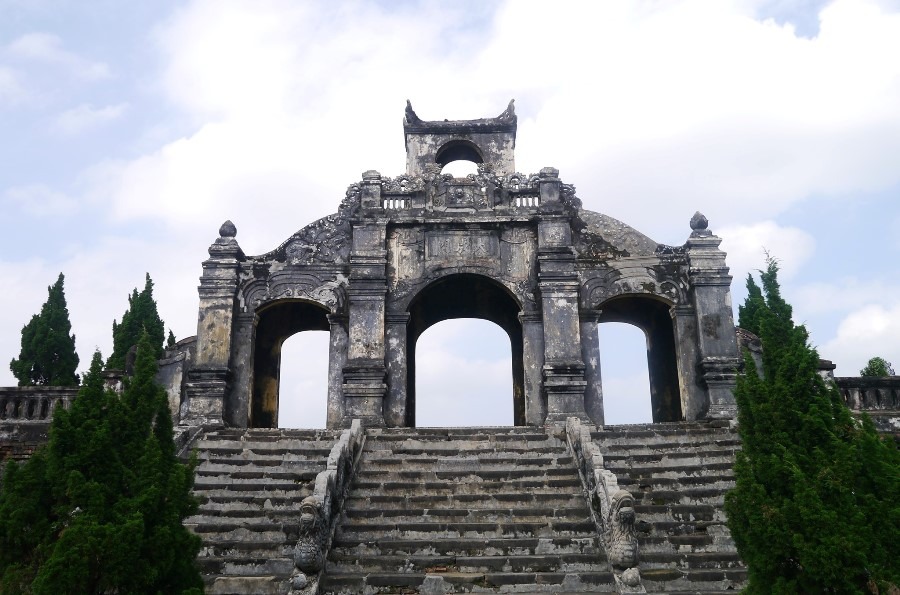
Compared to its original scale and grandeur, the Hue Temple of Literature has suffered significant damage over time, and today, only a few characteristic architectural structures remain. Much of the complex has weathered the impacts of history and natural conditions, leaving behind traces of its once-imposing appearance.

However, it is precisely this quiet, timeworn atmosphere that creates a unique and somewhat mysterious beauty. The moss-covered walls, ancient stone steles, and peaceful surroundings have transformed the site into one of the most atmospheric photography spots in Hue, attracting visitors who appreciate both history and poetic scenery.
The 32 Doctoral Tablets on Turtle’s Backs
Similar to the Temple of Literature in Hanoi, the Hue Temple of Literature preserves a remarkable collection of doctoral steles placed on the backs of stone turtles. These steles were erected during the reign of Emperor Minh Mạng to honor outstanding scholars of the Nguyễn Dynasty. In total, 32 stone steles record the names and hometowns of 293 doctoral laureates who successfully passed the imperial examinations.

According to Eastern philosophy, the turtle is one of the Four Sacred Animals, symbolizing longevity, wisdom, and enduring knowledge. For this reason, having one’s name engraved on a stele carried by a stone turtle was considered an immense honor and a lasting recognition of academic achievement.
Linh Tinh Gate
Tinh Linh Gate of the Hue Temple of Literature overlooks the poetic Perfume River, creating a graceful and symbolic entrance to the complex. The gate is designed with four sturdy brick pillars, forming a simple yet dignified architectural structure.
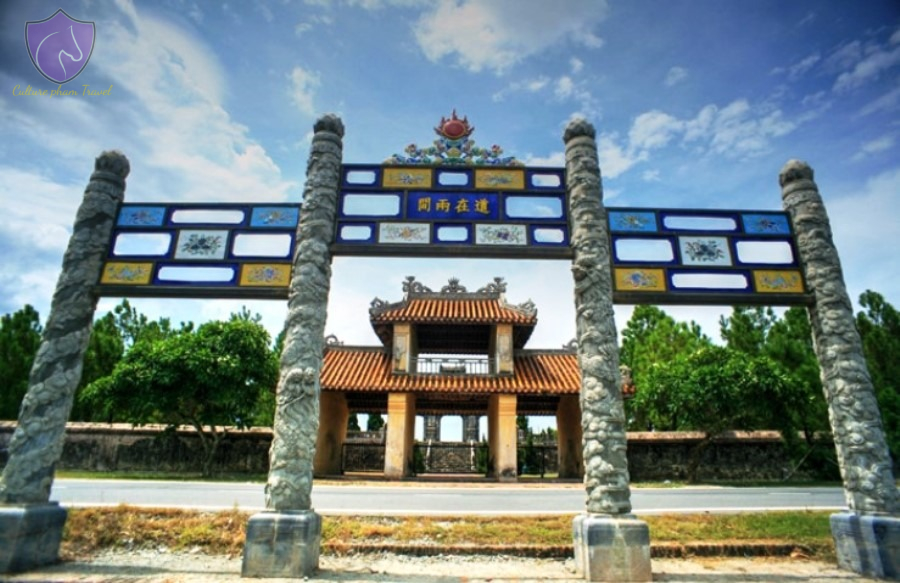
At the top, it is beautifully decorated with delicate Pháp Lam enamel work, a traditional royal decorative art of the Nguyễn Dynasty known for its vibrant colors and refined craftsmanship. On the front side of the gate, the inscription “Đạo Tại Lương Gian” is prominently displayed, while the back bears the words “Trác Việt Thiên Cổ.” Together, these calligraphic inscriptions convey profound Confucian meanings, honoring morality, virtue, and the enduring values of education through generations.
The Great Gate “Dai Thanh Mon”
The Great Gate, known as Đại Thành Môn, is one of the most representative structures that still preserves the distinctive features of ancient imperial architecture in the Hue Temple of Literature complex. The gate was constructed on a grand scale, reflecting the sophistication and craftsmanship of the royal artisans of the Nguyen Dynasty.

Despite the many historical changes and periods of decline, Đại Thành Môn continues to stand with dignity and strength, symbolizing the enduring spirit and noble character associated with Confucian scholars. Passing through the gate, visitors can look directly toward Đại Thành Điện (Confucius Temple), the central and most sacred building of the complex.
Đại Thành Điện was built on a high foundation, measuring approximately 32 meters in length and 25 meters in width. The temple follows traditional Hue architectural principles, featuring balanced proportions, harmonious layout, and refined decorative details that reflect both Confucian solemnity and imperial elegance.
Hue Temple of Literature Travel Guide
Opening Hours
The Hue Temple of Literature is open daily and accessible throughout the day, making it very convenient to include in your Hue itinerary. Visitors can explore the complex in the early morning for a peaceful atmosphere or in the late afternoon when the light becomes softer and more suitable for photography. Thanks to its flexible opening hours, the site can easily be combined with other nearby attractions.
Located only about 1 kilometer from Thien Mu Pagoda, the Temple of Literature is a perfect stop after admiring the sacred pagoda overlooking the Perfume River. Many travelers choose to visit both sites in the same morning or afternoon to better understand Hue’s spiritual and educational heritage.
Entrance Fee
Currently, there is no entrance fee to visit this historical relic. Travelers can freely explore the courtyards, stone steles, gates, and remaining architectural structures without purchasing a ticket. This makes the Temple of Literature not only culturally valuable but also a budget-friendly attraction in Hue.
Important Visiting Guidelines
To help preserve this important heritage site, visitors are kindly asked to respect the historical structures and surroundings.
- Please do not touch, climb, draw on, or sit on the relics, stone steles, or statues.
- Avoid littering and help keep the area clean and peaceful.
- Maintain a respectful attitude, as this is a place that honors Confucius and generations of scholars.
What to Prepare
Hue’s weather can be quite hot, especially during midday from May to August. When visiting the temple, you should prepare:
-
A hat or umbrella for shade
-
Sunglasses and sunscreen
-
A bottle of drinking water
-
Comfortable walking shoes
These simple preparations will help you enjoy a more comfortable and relaxed visit.
FAQs
What is the importance of the Hue Temple of Literature?
It is a great symbol of Vietnam’s educational system under the Nguyen Dynasty. It shows that the emperors cared very much about education as well as developing the quality of the education system at that time.
What is the biggest architectural work in the Hue Temple of Literature?
The largest monument in the complex of the Temple of Literature Hue is the worshiping hall of Confucius, but it was destroyed in the War.
What does the Temple of Literature look like?
It is a huge complex of beautiful and grand gates, a worshiping area, as well as the doctoral tablets on the back of the turtles.
Why was the Temple of Literature built?
The Temple of Literature was built to worship and honor Confucius as well as encourage the talents who help the emperor develop the country. Nowadays, the Temple of Literature is a unique symbol of Vietnam’s educational system during the feudal times.