
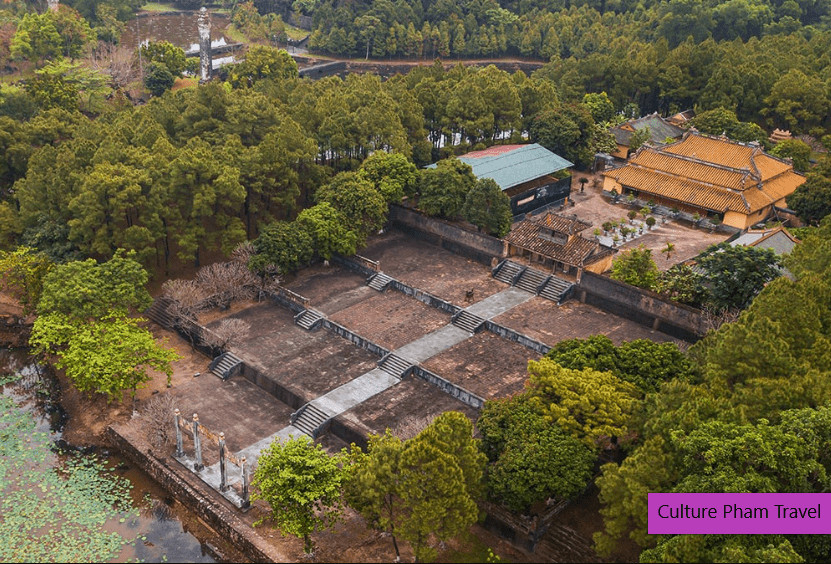
Thieu Tri Tomb Introduction
Thieu Tri Tomb, also known as Xuong Lang, is one of the famous Hue Royal Tombs of the Nguyen Dynasty. It is a relic in the complex of Hue monuments that was recognized by UNESCO as a world cultural heritage on December 11th, 1993. This is the resting place of Thieu Tri Emperor- the 3rd Emperor of the last Vietnam feudalism.
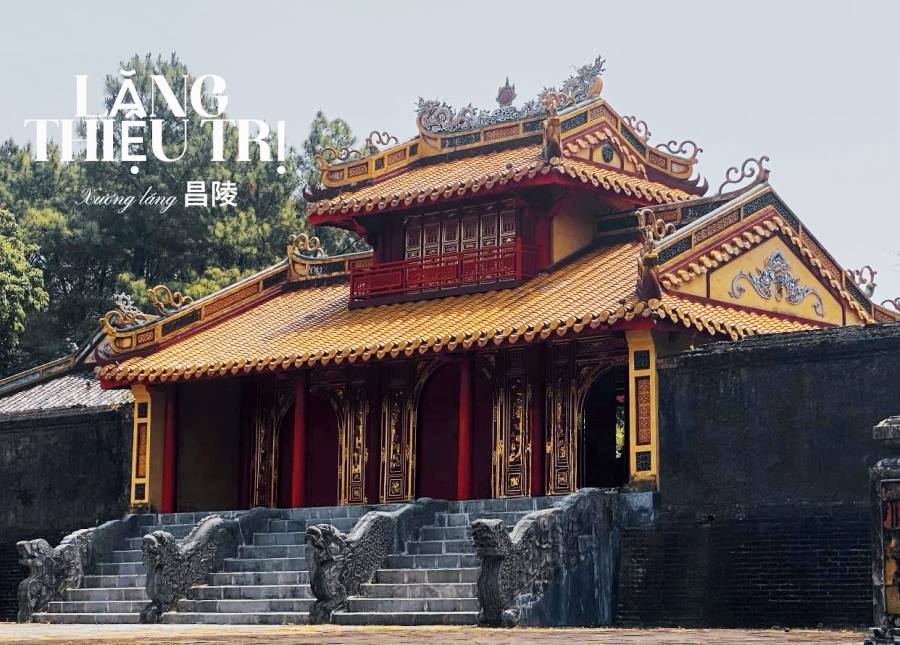
Although there are many similarities in setting and architecture between Gia Long Tomb and Minh Mang Tomb, Thieu Tri Tomb still has its own unique features.
During your lovely stay in Hue City, you may be interested in our Hue Tours, such as Hue Royal Tombs Tour, Hue City Private Tour, Hue Luxury Group Tour, Hue Street Food Tour, Bach Ma National Park Tour, DMZ Tour from Hue, etc.
Tomb Of Thieu Tri Location
Thieu Tri Tomb, whose literal name is Xuong Lang, is located in Cu Chanh village, Thuy Bang commune, Hue City, about 8km south of the Hue citadel.
How to get to the Tomb of Thieu Tri?
Located quite close to the center of Hue city, it is not too difficult for you to find the Royal Tomb of Thieu Tri Emperor. You can get to the mausoleum by bicycle, taxi, motorbike, Hue Private Car, or by the following road:
Starting from Dien Bien Phu Road, you go straight ahead to Nam Giao Esplanade. At the intersection, you turn left to Minh Mang Road. At the Hong Duc Pagoda junction, then turn right, and keep going about 2km, you will see the Thieu Tri Tomb Hue on the left.
You can go to Thieu Tri Tomb by riding a bike or driving a car. For more convenience, you may also book a Hue City Private Tour to get the full enjoyment of your Hue day trip.
Thieu Tri Emperor Biography
Thieu Tri is officially called Nguyen Phuc Mien Tong (1807 – 1847) – the third Emperor of the Nguyen Dynasty, the eldest son of King Minh Mang. After ascending the throne for 7 years, Thieu Tri King fell ill and passed away on November 4, 1847, at the age of 41.

When he was alive, he did not think about building a mausoleum for himself, so when King Thieu Tri passed away, his body was laid to rest at Long An Palace, Bao Dinh Palace for 8 months. Tu Duc Emperor (the son of Thieu Tri) ascended the throne and built a royal tomb for his father.
Thieu Tri Tomb Construction History
Regarding the history of the Thieu Tri mausoleum, according to the old records, after being on the throne for 7 years, Thieu Tri King fell ill and passed away on November 4, 1847.
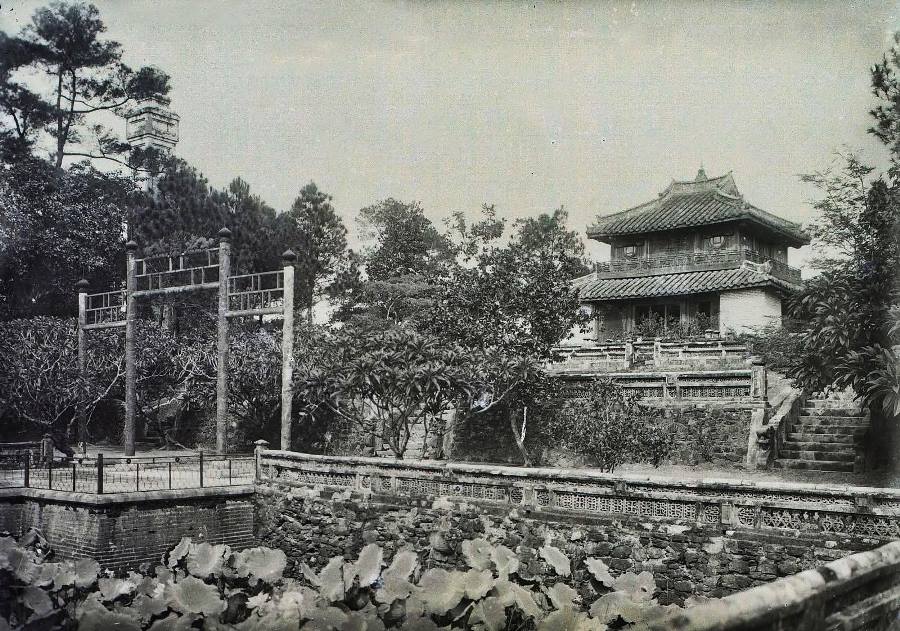
When he almost entered the afterlife, the king admonished: “The land for making a royal mausoleum should be chosen on high ground at the foot of the mountain. That makes it convenient for the militia to build the royal tomb”.
King Thieu Tri’s Mausoleum in Hue still retains its rare pristine beauty.
“As for the underground tunnel to take the coffin to the grave, starting from Hieu Lang, you should imitate it. As for the temples which are built for the purpose of worshiping, they should be made as simple as possible to not waste money on the resources of the people.”
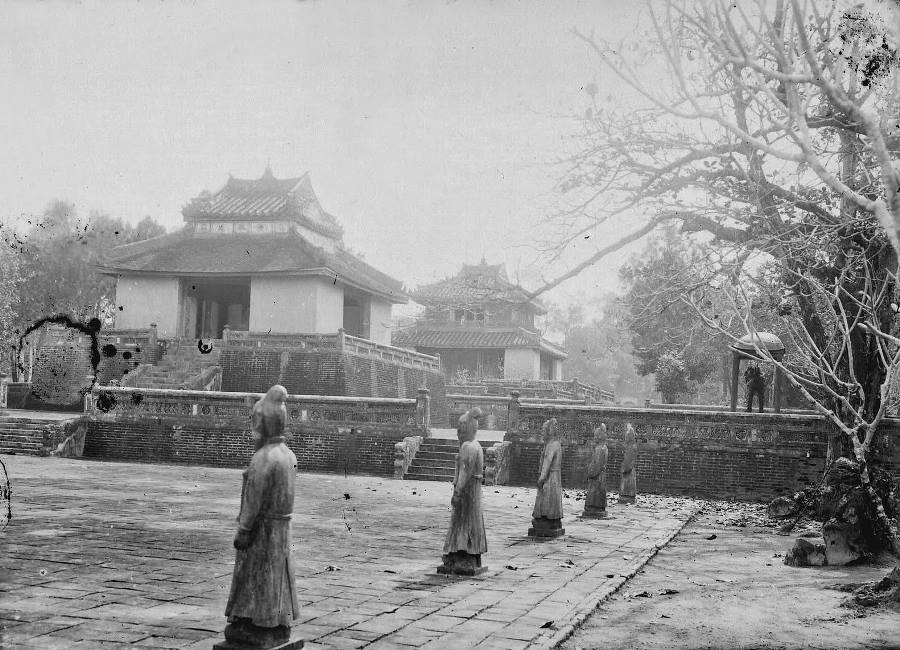
Tu Duc Emperor wrote an epitaph of over 2,500 words and had it engraved on the stele “Thanh Duc Than Cong”. It was erected on November 19, 1848, to praise the merits of his father. Thus, from the date of construction to the date of completion, the Thieu Tri mausoleum was constructed in less than 10 months.
After many ups and downs in history, nowadays, Thieu Tri’s Tomb in Vietnam has deteriorated heavily. This situation makes the royal tomb not visited by many tourists, unlike the tombs of Minh Mang, the royal tomb of Tu Duc, and Khai Dinh. In March 2006, the Ministry of Culture and Tourism issued a decision to restore and embellish Xuong Lang, with a total investment of more than 106 billion VND.
Thieu Tri Royal Tomb Architecture
The royal tomb of Thieu Tri is considered a combination of two architectural models of his two predecessors’ tombs. The Thieu Tri Tomb is similar to the Gia Long Tomb in that there is no La Thanh (surrounded wall), and the burial area and the worship temple are separate and parallel.
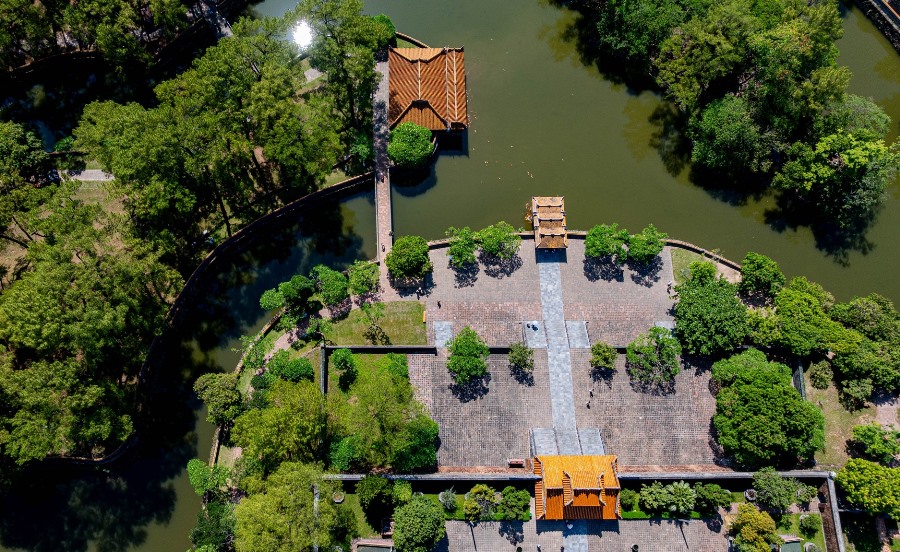
The Thieu Tri Tomb is similar to the Minh Mang Tomb in its burial and the construction of Toai Dao (the axis). Buu Thanh is round with a semicircular lake of Ngung Thuy wrapped in front.
The structure of King Thieu Tri Hue’s mausoleum includes 2 main areas: the burial area on the right, and the worshiping area on the left.
The Burial Area
The burial section lies to the right, with Nhuan Trach Lake in front. This lake is connected to the lake in front of the temple area through an underground drainage system and continues to Ngung Thuy Lake in front of the Buu Thanh, creating a winding “flowing water” landscape that gently surrounds the tomb complex.
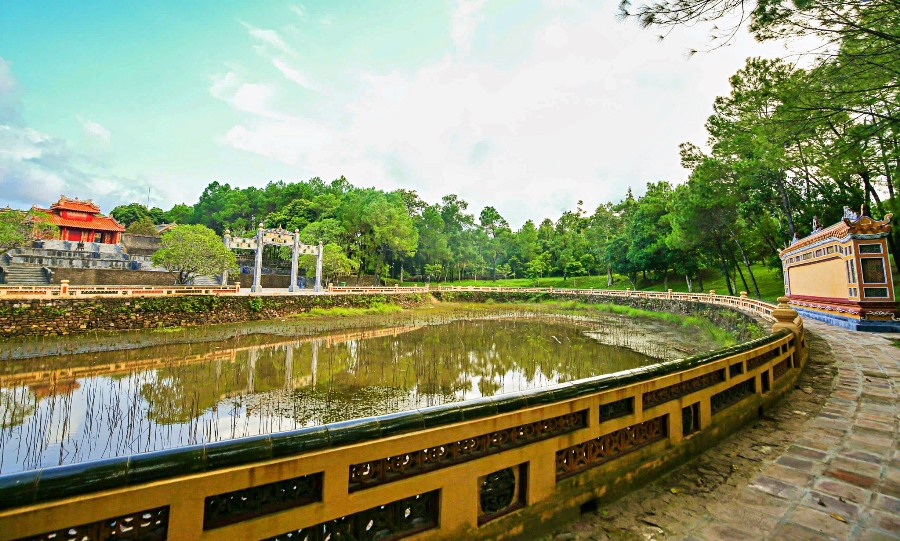
Just behind Nhuan Trach Lake stands a bronze ceremonial gate cast in the “dragon-cloud pillar” style, leading to the spacious Bai Dinh courtyard. On both sides of the courtyard, rows of stone statues of horses, elephants, and civil-military servants are typical of the art of statue carving in the first half of the 19th century in Hue.
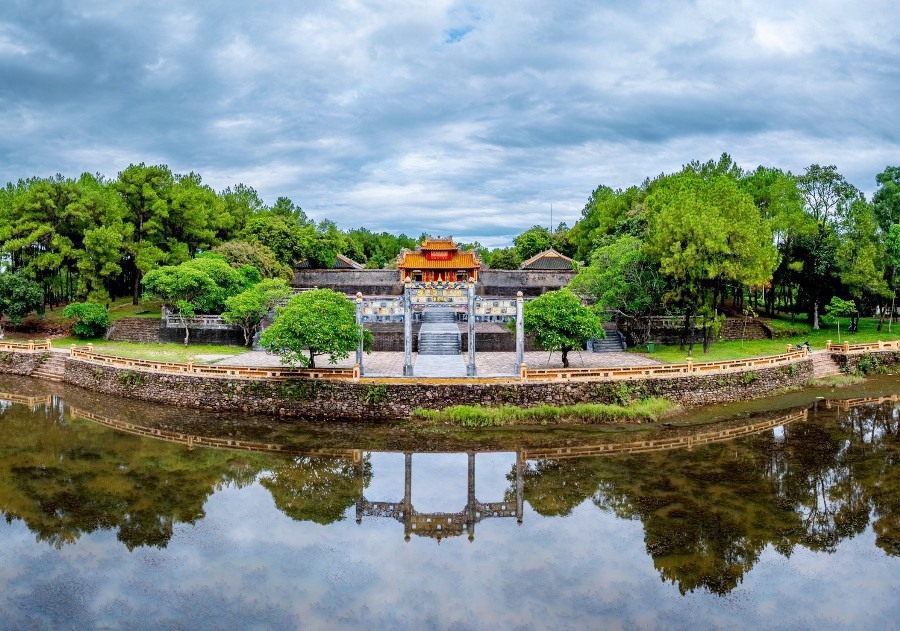
Next is the stele pavilion (Bi Dinh), designed in a square form, followed by Duc Hinh Pavilion, which sits atop a low hill shaped like a turtle shell. The designers of Thieu Tri’s tomb separated the temple area from the layout of Minh Mang’s tomb and then adapted and refined it to harmonize with the natural landscape of the royal tomb of Thieu Tri Emperor.
As a result, the Bi Dinh and Duc Hinh Pavilions here echo the architectural style of the stele pavilion and Minh Lau Pavilion at Minh Mang’s tomb. From Duc Hinh Pavilion, looking toward the rear, reveals a magnificent view: Ngung Thuy Lake appears like a half-moon guarding the Buu Thanh. Three bridges- Dong Hoa (right), Chanh Trung (center), and Tay Dinh (left)- cross the lake and lead to the stone steps entering the Buu Thanh, where the emperor’s remains rest. Further to the right stands Hien Quang Pavilion, a symbolic place for the king’s contemplation in both the earthly and spiritual realms.
Worshiping area
Due to geographical constraints, Xuong Lang could not be built along a single longitudinal axis like Minh Mang’s tomb. Therefore, the temple area was constructed separately, about 100 meters to the left of Duc Hinh Pavilion.
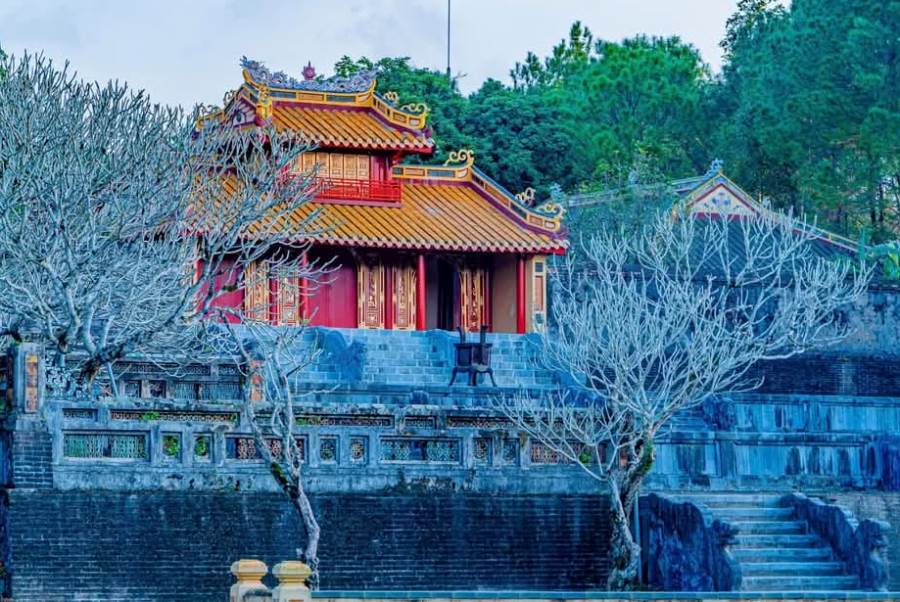
Just behind the temple lake stands a marble ceremonial gate, decorated with delicate enamel (phap lam) motifs, including floral patterns and a yin-yang (Taiji) symbol shaped like a wine gourd. At its center hangs a horizontal lacquered board inscribed with four Chinese characters: “Minh Duc Vien Hy” (Bright virtue endures afar), honoring the emperor’s legacy.
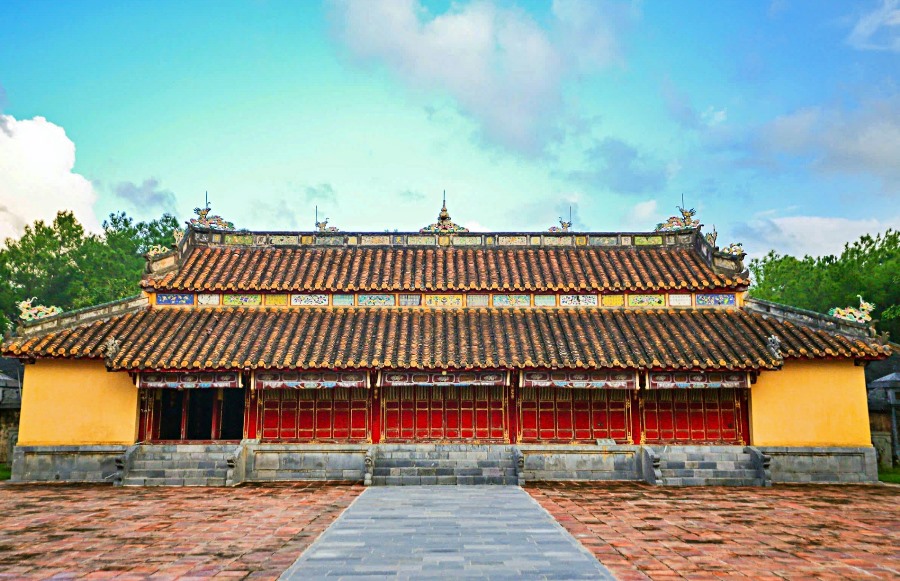
Ascending the steps into the Bieu Duc Temple area, visitors pass through Hong Trach Gate, facing north. This structure resembles observation towers such as Hien Duc Gate at Minh Mang’s tomb and Khiem Cung Gate at Tu Duc Tomb. At the center stands Bieu Duc Temple, dedicated to the ancestral tablets of the emperor and Empress Tu Du.
Inside the main hall, more than 450 carved inscriptions of poems can be found on the roof beams and gate structures, holding significant literary and educational value. Surrounding the temple are auxiliary buildings – Ta and Huu Phoi Dien in the front, and Ta and Huu Tung Vien at the rear, enhancing the solemn and noble atmosphere of the entire complex.
Thieu Tri Royal Tomb Unique Feature
Unique mausoleum Feng Shui
The tomb was built facing the Northwest, a direction never used in major architectural works in Hue at that time. In addition, Vong Canh Hill is located about 1km away from the mausoleum, with Ngoc Tran Mountain on the left side facing the mausoleum. Giving the mausoleum the position of “the left Dragon, the right Tiger”.
The “prejudice” for the Thieu Tri Tomb, Hue, Vietnam area is Cham Mountain, about 8km away, and the Bau Ho cave is located closer as a natural screen for the impregnated area.
A peaceful scene of the countryside
Surrounding the tomb of King Thieu Tri Hue is a peaceful scene of the countryside, verdant trees, and green fields stretching. Moreover, to the front of King Thieu Tri Hue’s mausoleum is the tomb of Hieu Dong (of the king’s mother, Mrs. Ho Thi Hoa). Behind the left is Xuong Tho Lang (of the king’s wife – Ms. Tu Du). In front of the grave area is the resting place of the children of King Thieu Tri, who passed away at a young age.
Thieu Tri Tomb Entrance Fee & Opening Hours
Currently, the latest updated ticket prices for Thieu Tri Tomb are as follows:
– Adults: 50,000vnd/ticket.
– Children from 7 to 12 years old are free.
The mausoleum is open to visitors on all days of the week, from Monday to Sunday (7 am – 5:30 pm).
The Best Time To Visit?
According to Culture Pham Travel’s travel experience, the weather in Hue is most pleasant from January to April every year. Because this is the right time for you to visit the mausoleum as well as other tourist places in Hue. The mausoleum complex is also quite small, so you can only spend 1-2 hours exploring it all.
In conclusion, Culture Pham Travel hopes our sharing of the Thieu Tri Tomb will help you on your upcoming discovery trip! Let’s book a Hue Royal Tombs Tour to explore ancient tombs in Hue City.
Regulations for visiting the Thieu Tri Royal Tomb
When visiting Thieu Tri Royal Tomb, there are no overly strict or complicated rules, but as a UNESCO heritage site and sacred royal mausoleum, visitors are expected to follow certain regulations and cultural etiquette.
Here are the main regulations and guidelines:
✓ Wear polite and respectful clothing (no short shorts, crop tops, or overly revealing outfits).
✓ This is a spiritual and historical site, so modest dress is expected.
✓ Keep a quiet and respectful attitude while visiting.
✓ Avoid loud talking, shouting, or disruptive behavior.
✓ Do not sit or climb on altars, statues, or royal structures.
✓ Do not touch ancient objects, carvings, or architectural details.
✓ Avoid leaning, scratching, or writing on walls or monuments.
The tomb is part of the Hue Monuments Complex, so preservation is strictly enforced.
✓ Stay on designated paths and walkways.
✓ Obey instructions from staff or guides.
✓ Some restricted areas may not be open to visitors.
Photography is generally allowed, but:
✓ Avoid inappropriate poses (especially in sacred areas).
✓ Do not use drones unless permitted.
✓ Be respectful when taking photos near worship spaces.
✓ Do not litter; keep the site clean.
✓ Protect the natural landscape (trees, lakes, surroundings).
General Travel Tips
✓ Visit early morning or late afternoon for a peaceful experience.
✓ Bring water, sunscreen, and comfortable walking shoes.
✓ Since the site is quieter than other tombs, facilities may be limited.
Pingback: HUE Entrance Fee Monuments in 2022 - Culture Pham Travel
Pingback: TOP HUE ROYAL TOMBS YOU MUST VISIT - Culture Pham Travel